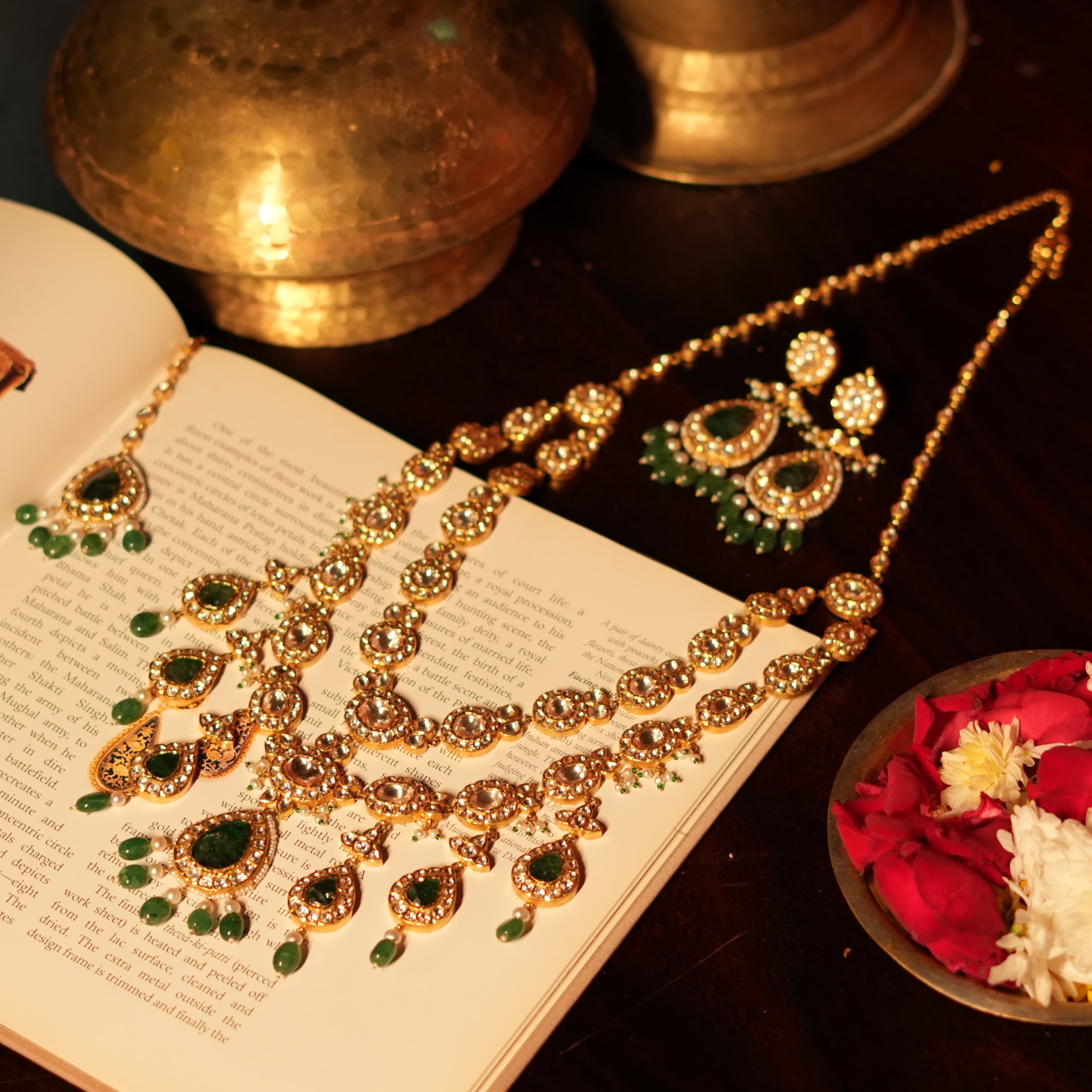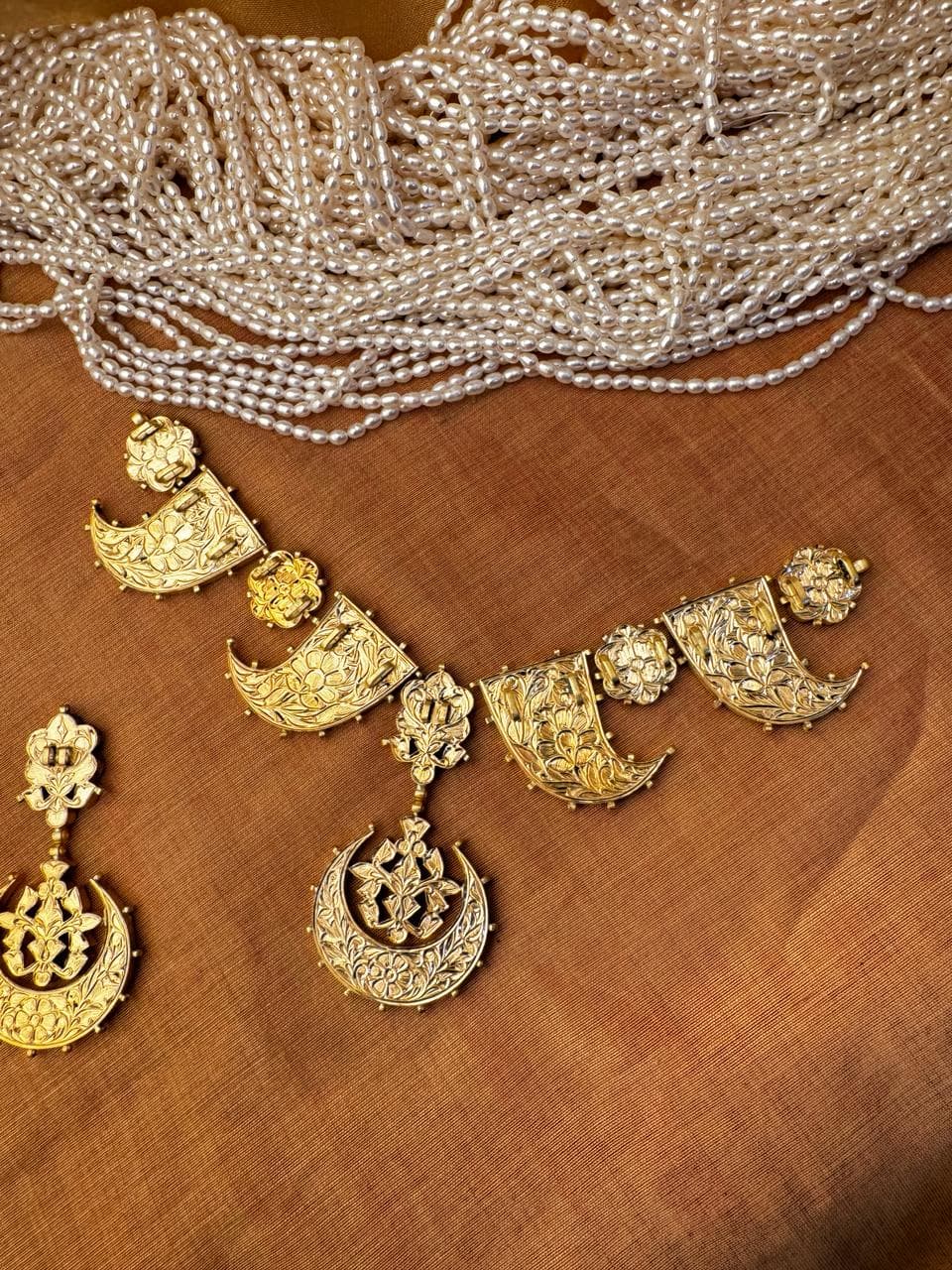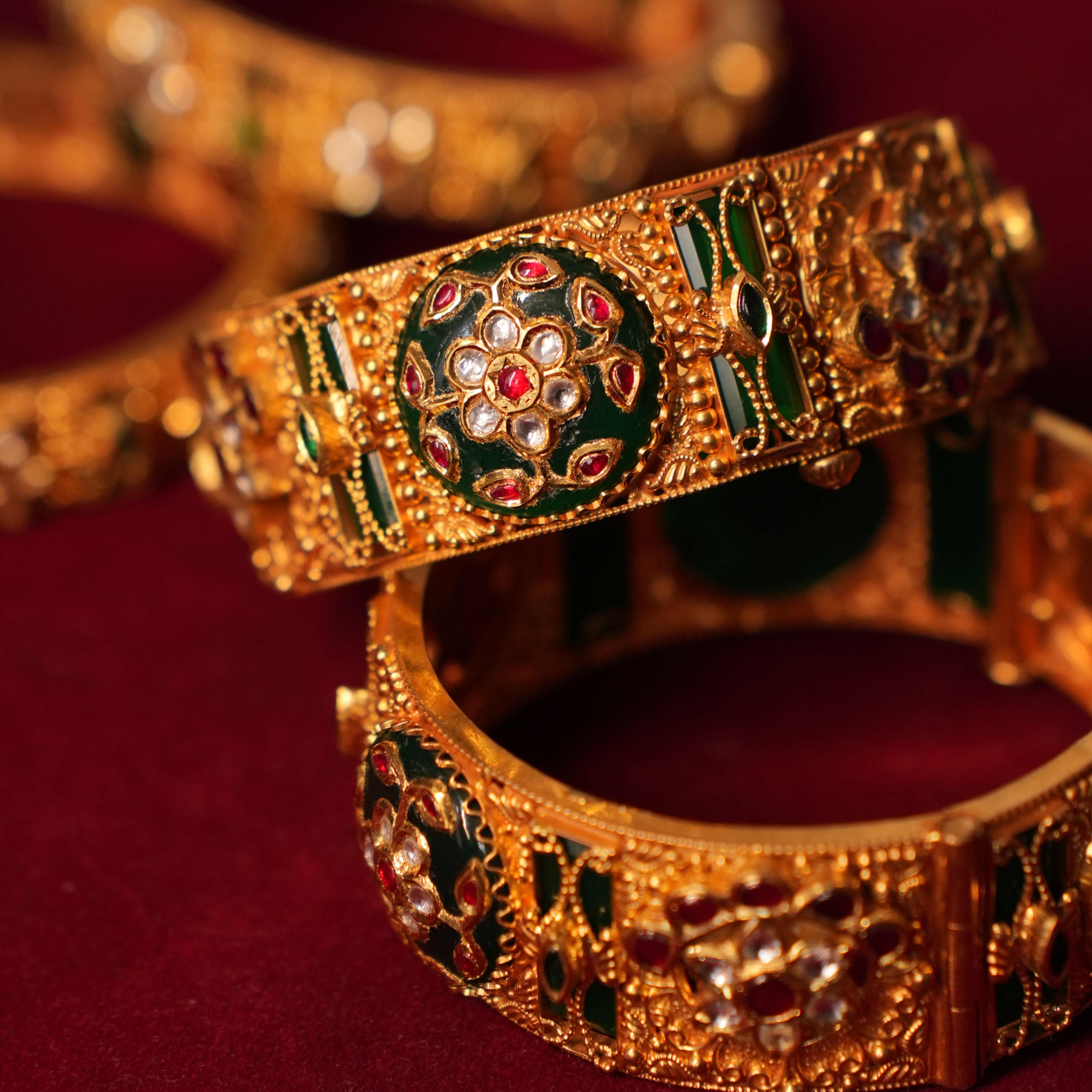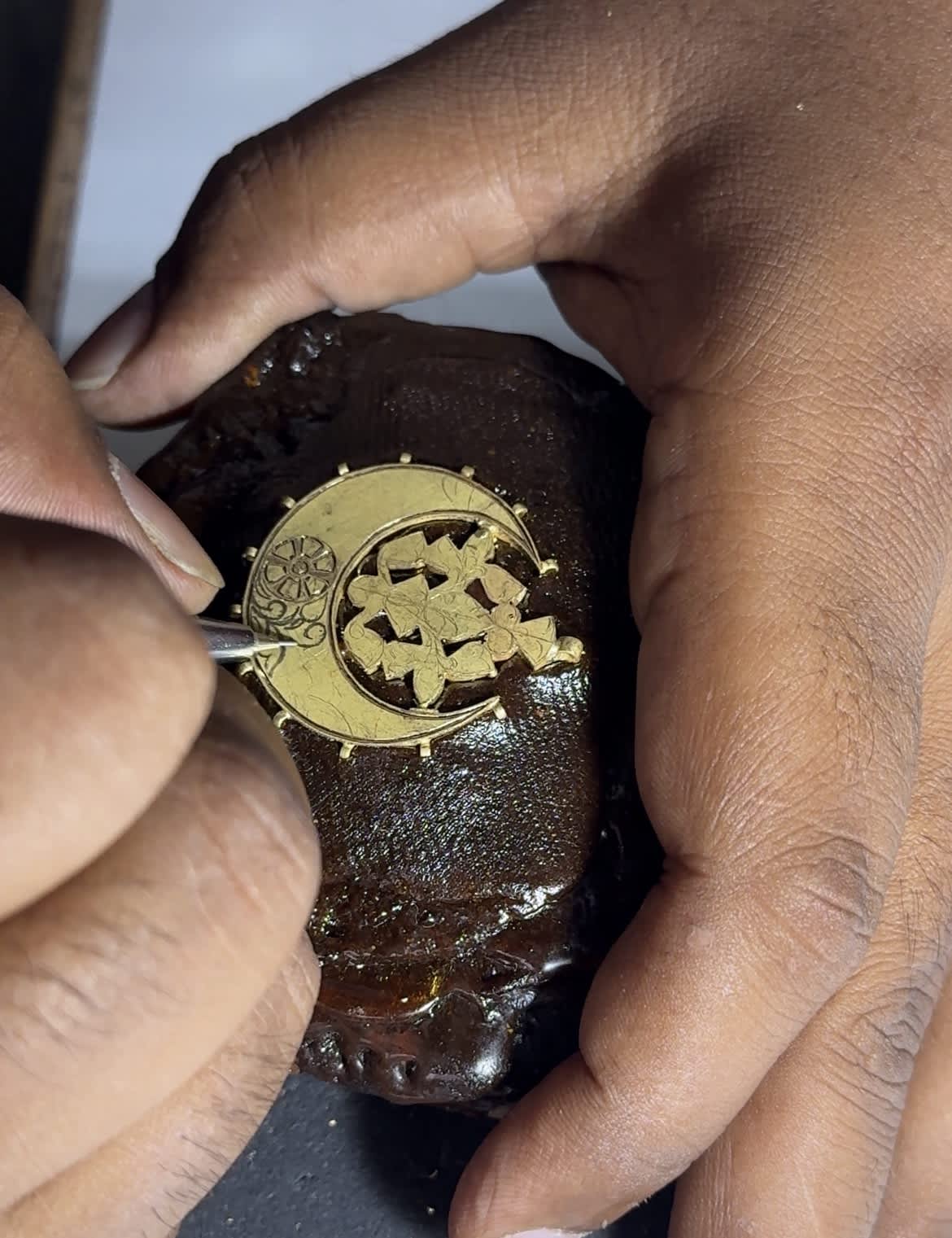
In Rajasthani bridal traditions, the ornaments worn on the head are not merely accessories - they are among the most symbolically significant pieces in the entire trousseau. The way a bride adorns her forehead and hair parting tells a story of region, community, and family. Three distinct headpieces define this tradition: the maang tikka, the matha patti, and the borla.
The Maang Tikka: Grace at the Parting
The maang tikka is the most widely recognised Indian bridal headpiece. It consists of a single pendant that hangs at the centre of the forehead, suspended from a chain or hook that follows the hair parting (maang).
In its simplest form, a maang tikka is a single polki or gemstone pendant on a fine chain. In more elaborate versions, the chain itself is jewelled, with small stone clusters leading from the crown of the head down to the central pendant. The pendant may be circular, teardrop-shaped, or crescent-shaped, depending on regional style.
The maang tikka holds special significance in Indian tradition. The centre of the forehead is associated with the ajna chakra (the sixth chakra, or third eye), representing intuition and wisdom. The tikka at this point is both decorative and symbolically auspicious.
The Matha Patti: Framing the Face
The matha patti takes the concept of the maang tikka and expands it dramatically. Rather than a single pendant on a chain, the matha patti consists of chains and jewelled elements that extend across the forehead and along the hair parting, sometimes reaching to both sides of the head.
A full matha patti typically includes:
A central pendant - Similar to a maang tikka, this anchors the design at the centre of the forehead.
Side chains - Jewelled chains extend from the central pendant along the hairline, framing the face on both sides. These may be single or multiple strands.
A parting chain - A decorated chain runs along the hair parting from the forehead to the crown, often secured with small hooks or pins.
The matha patti creates a stunning frame for the bride's face and works particularly well with centre-parted hairstyles. It is a hallmark of North Indian and Rajasthani bridal looks, adding an element of regal grandeur that no other ornament can replicate.
The Borla: Distinctly Rajasthani
The borla is perhaps the most distinctive headpiece in Indian jewellery, and it is uniquely associated with Rajasthan - particularly with the Marwari and Rajput communities. Unlike the maang tikka's pendant or the matha patti's chains, the borla is a round, dome-shaped ornament worn at the centre of the forehead.
A traditional borla is substantial - a spherical or hemisphere-shaped piece, often set with polki diamonds, surrounded by pearls, and finished with meenakari on the back. It is attached to the hair with a sturdy chain or cord that runs along the parting.
The borla's distinctive shape sets the Rajasthani bride apart immediately. It is bold, unmistakable, and carries the weight of Marwari tradition. In some communities, the borla is gifted by the groom's family as part of the wedding gifts, adding a layer of familial significance to its wearing.
Regional Variations Within Rajasthan
Jodhpur - Jodhpuri borlas tend to be elaborate, with heavy polki work and deep red and green meenakari. The Marwar region's bold aesthetic is reflected in substantial pieces that make a powerful visual statement.
Bikaner - Bikaneri headpieces are known for their lighter, more intricate construction. The meenakari work often features a distinctive pink and white palette that sets it apart from the bolder Jodhpuri style.
Udaipur - The Mewar tradition favours elegance and refinement. Udaipur headpieces often feature finer chain work and more delicate pendant designs, reflecting the Mewari aesthetic of understated grandeur.
Jaipur - As the state capital and a major jewellery hub, Jaipur offers a blend of all Rajasthani styles, often with a contemporary twist. Jaipur matha pattis frequently incorporate coloured gemstones alongside polki for a vibrant effect.
How to Wear Them with Different Hairstyles
The success of a bridal headpiece depends significantly on the hairstyle:
Centre parting with a low bun - The classic choice for maang tikka and borla. The clean parting provides a clear path for the chain, and the low bun allows the back of the chain to be secured neatly.
Centre parting with loose curls - Works well with a matha patti, where the side chains can be woven through the curls for a romantic, flowing look.
Side parting - Less traditional but increasingly popular. A maang tikka can be adapted to sit slightly off-centre. A borla, however, traditionally requires a centre parting.
Braided hair - A single braid or fishtail pairs beautifully with a matha patti, especially if the parting chain is extended down the back along the braid.
Choosing Your Headpiece
At SHRIVATSA, we craft all three headpiece styles in the traditional Jodhpuri manner - each hand-formed, hand-set with polki, and finished with meenakari on the reverse. We work with each bride to determine which style best suits her face shape, hairstyle, and outfit, ensuring that the headpiece becomes the crown it is meant to be.